Light Sheet Microscopy Systems for Biological Imaging


PhaseView designs and manufactures light-sheet fluorescence microscopes for biological research. Our modular platforms combine optical engineering, flexible sample mounting and dedicated acquisition software to support a wide range of imaging experiments.

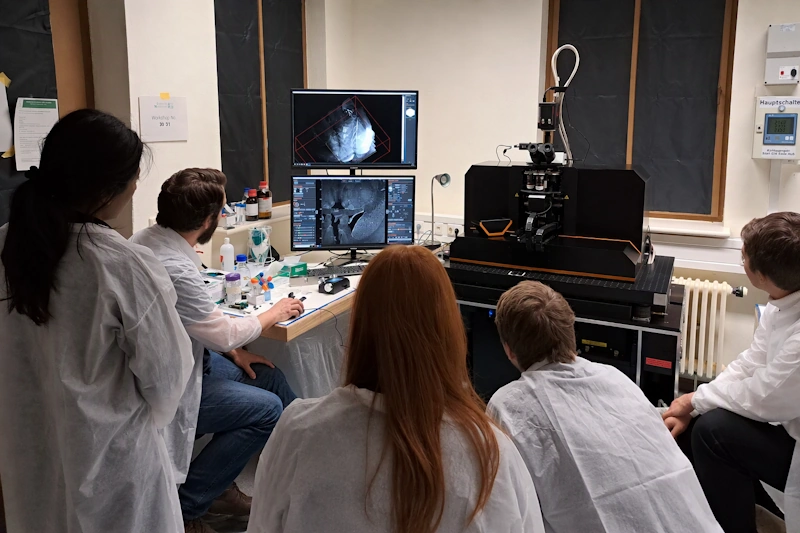
Alpha3 FE light-sheet microscope surrounded by researchers during a system demonstration
Live demonstration of the Alpha3 Facility Edition light-sheet microscope.

Our systems capture three-dimensional images of living specimens, fixed samples, cleared tissues and whole organs. Selective plane illumination microscopy (SPIM) combines light-sheet excitation with camera-based fluorescence detection to record optical sections through the specimen.

Different configurations support different sample preparations, imaging scales and experimental workflows, from time-lapse imaging of living samples to the examination of large cleared specimens.

PhaseView systems are used at research institutions around the world, including Sorbonne Université, Université Paris-Saclay, the Hebrew University of Jerusalem, TU Darmstadt, UNSW Sydney and Université de Montréal.

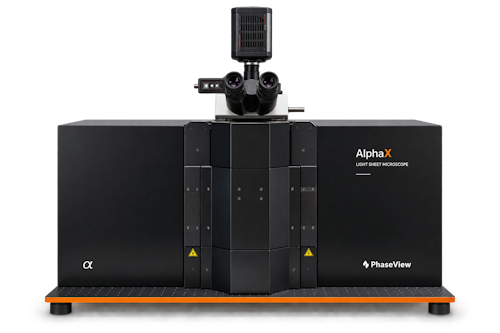
Introducing the New AlphaX Light-Sheet microscope

Alpha X is the newest light-sheet microscopy system from PhaseView, designed to extend the flexibility of our platform for advanced biological imaging.

The new system will make its first public appearance at Neuroscience 2026 in Washington, D.C., November 14–18. Visit us to see Alpha X and discuss your imaging applications with our team.

AlphaX Light Sheet Microscope

A Configuration for Your Research

Different experiments place different demands on a light-sheet microscope. Live specimens, cleared tissues and large samples require different optics, sample environments and acquisition settings.

PhaseView systems are modular. Compatible illumination and detection objectives, lasers, cameras, sample chambers and holders can be selected to match your specimens, imaging media and resolution requirements.

The open design keeps the sample accessible, making it easier to accommodate different mounting approaches and integrate additional experimental equipment where needed.

PhaseView’s UltraThin technology combines thin optical sectioning with focus sweeping to maintain image sharpness across the field of view. This helps capture fine structural detail without restricting observation to the central region of the image.

From Whole Samples to Regions of Interest


An imaging workflow can begin with an overview of the specimen, followed by acquisition of selected regions of interest at higher magnification. Multichannel imaging distinguishes fluorescent labels, while time-lapse acquisition follows changes over time. The examples below illustrate how these approaches can be applied to different biological samples.

Cleared Tissues and Whole Organs


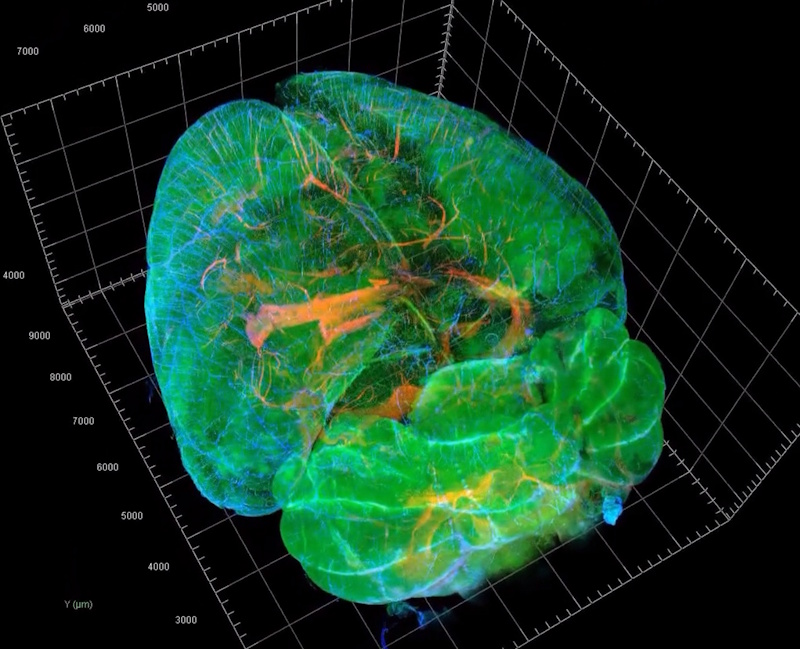
Explore the 3D organisation of cleared tissues and whole organs. Light-sheet microscopy records fluorescence throughout the specimen without physical sectioning, preserving the spatial relationships between labelled structures.

An overview reveals how labelled cells and networks are distributed across the sample. Selected regions can then be examined in greater detail while retaining their position within the surrounding tissue. This connects local observations with the anatomy of the whole specimen.

PEGASOS-cleared whole mouse brain. Life-act EGFP labels actin filaments; tdTomato-tagged MARCKS labels plasma membranes. Objective: 4×, NA 0.28, WD 30 mm.

Live Imaging and Development


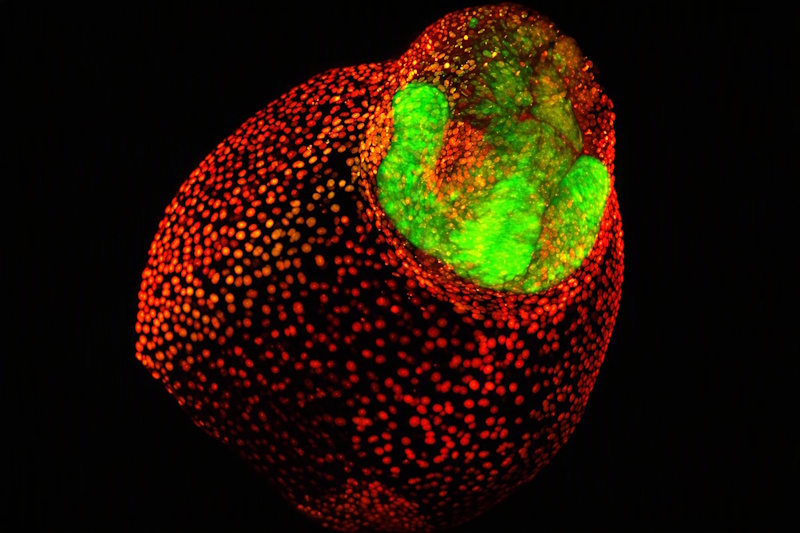
Follow development and cell behaviour over time. Multichannel time-lapse imaging records successive 3D volumes of a living specimen, allowing changes to be examined in their spatial context.

Researchers can observe growth, cell movement and changes in tissue organisation while distinguishing labelled structures in separate fluorescence channels. Viewing the resulting sequence in three dimensions helps relate individual events to the development of the specimen as a whole.

Astyanax development over 28 hours. Nuclei labelled with mCherry; cytoplasm in the head labelled with GFP.

From Whole Specimen to Selected Regions


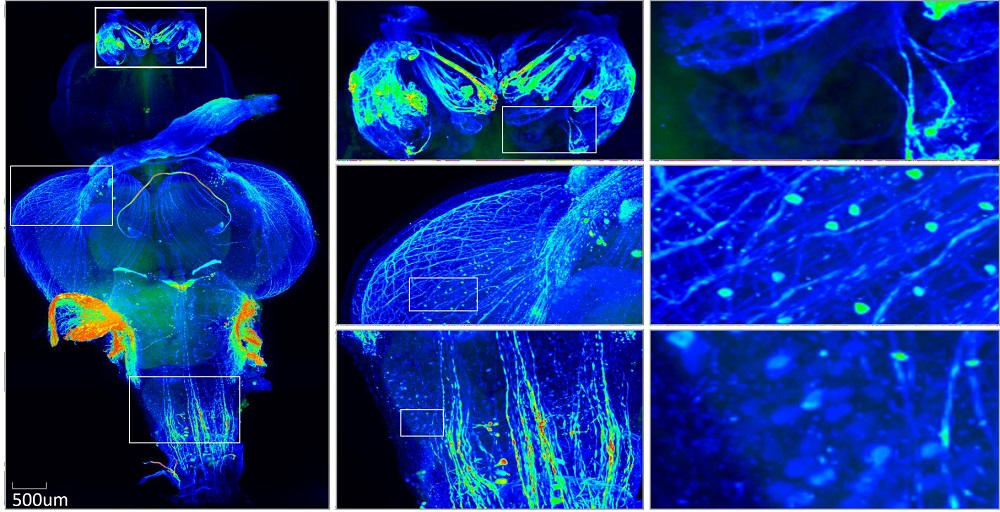
Start with a
whole-specimen overview, then examine selected regions of interest (ROIs) at higher magnification. This multiscale workflow connects fine structural detail with its anatomical location. It is useful when labelled structures are sparse or distributed across a large specimen.

Multiscale zebrafish imaging: from a whole-specimen overview to selected regions and fine structural detail

A System That Can Evolve with Your Research

Research changes over time. Your microscope should be able to change with it. Compatible components can be changed or added as your laboratory explores new samples, methods and research directions.

You do not need to choose a model or prepare a detailed specification before contacting us. Tell us about your research. We can help you select a suitable system and configuration and answer any questions you may have.

 PhaseView at Upcoming Conferences & Exhibitions


Meet our team
at the events below. Stop by to discuss your research, ask a question or learn more about our light-sheet microscopy systems.

Neuroscience 2026
November 14–18, 2026
Walter E. Washington Convention Center, Washington, D.C.

Cell Bio 2026
December 12–15, 2026
San Diego Convention Center, San Diego, CA

Focus on Microscopy 2027
March 21–24, 2027
Osaka International Convention Center, Osaka, Japan

ELMI 2027
June 22–25, 2027
Magazzini del Cotone Congress Centre, Genoa, Italy

Scroll to Top